
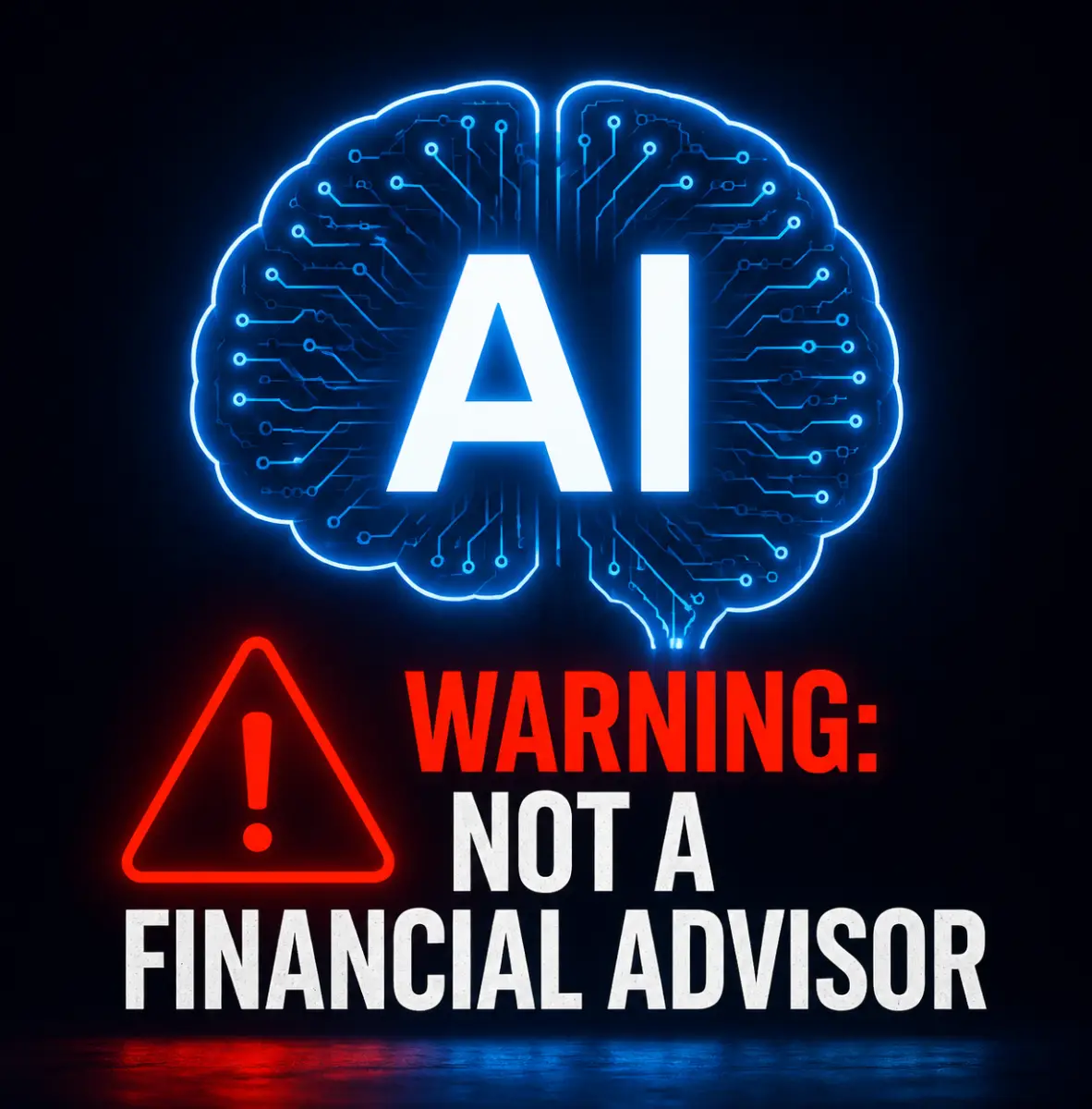
Don’t take financial advice from AI
By Vena Jones-Cox
Ya’ll.
PLEASE stop asking general-purpose AI for financial and real estate advice.
Or…go ahead and ask it. But don’t automatically do what it says.
I’m not saying AI isn’t useful. I use it every day.
And there are people building specialized GPTs and AI agents that are trained on particular kinds of deals, documents, financing strategies, and rules. Some of those may be genuinely useful—especially when they’ve been built and tested by people who actually understand the subject.
But asking Claude or ChatGPT:
“What should I pay for this property?”
“How should I finance it?”
“Is this a good creative-financing structure?”
“How do I make enough money to retire?”
…and then making a major financial decision based on the answer?
That’s…not…wise.
Oh, you’ll get an answer.
And the answer will SOUND very sensible and fact-based.
But here’s the thing about generic AI: It doesn’t actually know how to set an ARV for your specific deal.
I doesn’t know whether the rent estimate you gave it is realistic.
It certainly doesn’t know that a 125-year-old house in that particular neighborhood probably needs a much bigger maintenance reserve than the generic percentage it pulled from somewhere.
It doesn’t know whether your “creative” deal violates a state law, creates a tax problem, or depends on a seller, buyer, contractor, or property manager doing something they’re unlikely to do.
It doesn’t know what you forgot to tell it.
And it has no real-world judgment earned by watching hundreds of apparently good deals go bad.
The thing is, AI doesn’t know when it’s wrong, and it’s very comforting because it doesn’t sound uncertain when it’s wrong.
In that way, AI is dangerous for exactly the same reason so many inexperienced, half-baked influencers and gurus are dangerous:
It sounds very sure of itself.
It’s probably natively smarter than you.
And also, you don’t yet have enough knowledge or experience to separate the genuinely useful advice from the hallucinations.
AI is a tool. It can help an experienced person work faster, test assumptions, spot possibilities, and identify questions that need answers.
It can be PROGRAMMED by experienced people to do all kinds of things that are super-useful to real estate investors.
But ChatGPT? Claude? Perplexity? Gemini? Grok? We can all argue about which one is the “best for real estate investors” (at least today)…
But NONE OF THEM are a substitute for an experienced investor, CPA, attorney, financial planner, lender, or other qualified professional who understands your actual situation—and whose advice has real-world consequences to them.
Someday, that may not be true, and when that day comes real estate investing will be an entirely different business. No buyer or seller will have any advantage—no inside knowledge, no superior experience. We’ll all know exactly what to pay for any given property, and what the terms should be. The only way to get the property you want will be the one who wants it badly enough to pay more. It’ll be an interesting transition.
But today is not that day.
Don’t let AI do your thinking for you.
Get people instead—people who have the experience to give you good advice, and the heart to give it to you.
And for the love of all that is holy, don’t make any decisions you can’t take back because a chatbot confidently told you it was a good idea.
Check with your people first.
FOR REIA AND COREE
Look, we LOVE AI.
We know it’s a big player in the future of the real estate business…and we train on it all the time.
But PLEASE stop taking financial and real estate advice from general-purpose AI.
Or go ahead and ask it your real estate questions…
Just don’t automatically do what it says, OK?
ChatGPT, Claude, Gemini, Grok, and Perplexity can calculate numbers, explain terms, test assumptions, and suggest questions to ask. Specialized AI tools built and tested by experienced professionals may be even more useful.
But generic AI doesn’t actually know:
• Whether the ARV or rent estimate is realistic
• Whether a 125-year-old house needs a much larger maintenance reserve
• Whether a creative-financing structure creates legal or tax problems
• Whether the people involved are likely to do what the plan requires
• What important fact the person asking forgot to mention
And it has no judgment earned by watching hundreds of apparently good deals go bad.
The danger is that AI doesn’t sound uncertain when it’s wrong. It can deliver a sensible, detailed, extremely confident answer based on a bad assumption, outdated information, or a complete hallucination.
(By the way, that’s also why inexperienced gurus and influencers can be so convincing and are so dangerous: they sound sure of themselves, and the people listening may not yet know enough to separate good advice from nonsense.)
AI is a tool. It is not a substitute for an experienced investor, CPA, attorney, financial planner, lender, or other qualified professional who understands the actual situation.
So don’t let AI make decisions for you.
Get people instead—people with the experience to give good advice and the heart to share it.
That’s one of the biggest reasons COREE exists: to give real estate entrepreneurs a community of experienced people to ask before making decisions they can’t easily take back.
Ask AI if it helps.
Then check with your people.
Find your people at COREE.
Leave a Reply